Détente in 1941-1991 The Cold War
Exam Tip
Détente must be prepared; it’s relatively straightforward.
- détente was just containment in a nice, branded trenchcoat
- the U.S. still sought to limit Soviet power
- the USSR saw détente as a way to consolidate its European position
- or… they both still wanted opposing things 😭
- achieved its greatest success in 1970s
Involved
- 🇨🇳 Communist China
- 1921-1991 🇷🇺 Communist Russia
- 🇺🇸 United States of America
Linkage
- linkage: U.S. tried to persuade USSR and China to control Developing World revolutions, in return for American concessions in nuclear and economic fields
- pursued in 1970s
- replaced “rolling back” communism, by Nixon & Kissinger
- it DIDN'T WORK – the Soviets sometimes backed revolutions, but many were independent → this strategy was UNDERMINED
- U.S. would accept USSR nuclear gap closing + not interefere in Soviet spheres of influence + offer Western tech and investment
- USSR would extract the U.S. from Vietnam + accept that both parties had an interest in stabilizing/maintaining stability of the Developing World
- Nixon Doctrine, 1969: direct U.S. involvement in Developing World could be superseded by supply of weapons and training to ‘client’ states
Goals of détente
USSR
- stabilize arms race after U.S. advantage was neutralized
- Soviets wanted to reduce money spent on nuclear weapons + found it more expensive & difficult to keep up with American tech
- strengthen détente and Ostpolitik in Europe to gain legal recognition from U.S. and NATO of German Democratic Republic (East Germany) + Poland and Czechoslovakia’s post-1945 borders
- encourage East-West trade → Soviet & E. Europe access to Western technology & finance
- neutralize threat of PRC-U.S. alliance by giving U.S. and NATO states good relations with the USSR (and leverage to maintain those relations)
USA
- strengthen NATO allies’ relations esp. W. Germany
- W. Germany actively sought détente in the form of new Ostpolitik with the USSR, Warsaw Pact
- faciltate settlement in Vietnam → US can withdraw without Major Embarrassment
- halt escalating arms race
- fiscally a good decision on both sides
- create new international order throuhg détetne (aka containment in a trench coat) → discourage USSR from undermining NATO and US
STOP HERE
Causes of détente
USA
- political – loss of prestige at home and abroad + trade-off of forcing the USSR to force a North Vietnamese withdrawal
- economic – strain of supplying the war
- social – general unhappiness with the war and its impact in the U.S.
USSR
- economic
- 1969: stagnation of the Soviet economy
- bureaucratic inefficiency
- heavy burden of defence spending required to match U.S. military developments (arms race)
- 1970s: Soviet spending, on defence and aid to developing countries, increased + Brezhnev ignored the signs of economic decline
- Brezhnev simply said “if i close my eyes it is not real” (it was, in fact, tragically real)
- find stats
- Brezhnev-Kosygin team wanted to import new technology from more advanced Western economies + increase trade generally → we need to End détente
- 1969: stagnation of the Soviet economy
- political/military
- fear that the risk of nuclear war was increasing
- 1960s: USSR closed the missile gap with the U.S. at least in some areas (USSR had 1300 ICBMs to the USA’s 1054 ICBMs)
- though ICBMs had been superseded by SCBMs
- ICBMs: Inter-Continental Ballistic Missiles
- SCBMs?
- 1960s: USSR closed the missile gap with the U.S. at least in some areas (USSR had 1300 ICBMs to the USA’s 1054 ICBMs)
- the USA no longer had the overwhelming nuclear superiority it had enjoyed since 1945 → Soviet leadership believed the U.S. might be prepared to join talks on arms reduction
- no point in keeping up the arms race if both sides were more or less equal → hoping to force peace talks
- such talks had failed previously because the U.S. pushed for a freeze on armaments which maintained Soviet inferiority
- fear that the risk of nuclear war was increasing
- political – foreign policy, Sino-Soviet Split, which widened since 1960s
- 1969: border disputes and armed clashes along the 📍 Ussuri River almost resulted in war
- Soviet feared an anti-Soviet alliance between the USA and China (Sino-American Rapproachmen) → the Soviets had to court the USA first and improve relations FAST
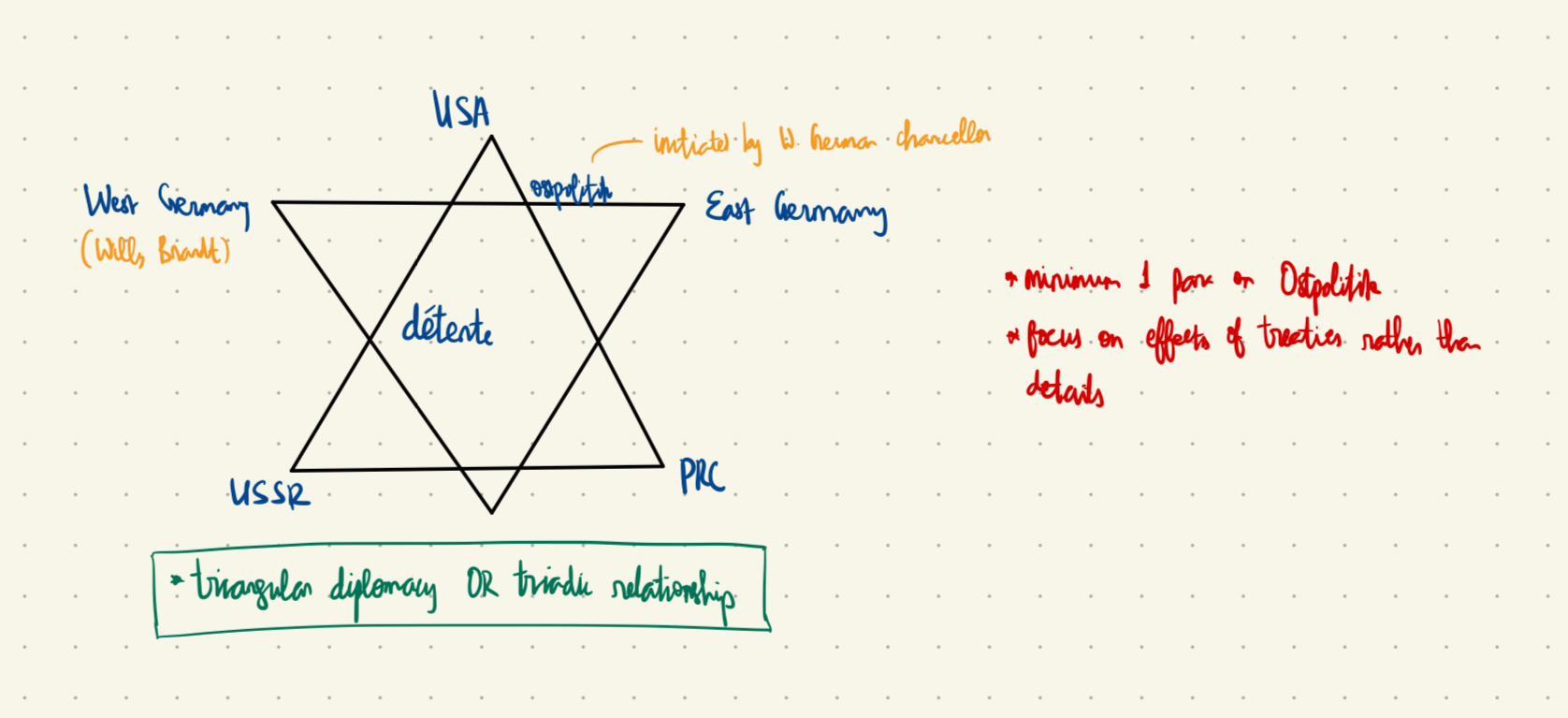
Triangular diplomacy (summary of relationships)
Successes of Détente
1972-1976 Sino-American Relations
- 1956-1991: Sino-Soviet Split
- soured Sino-Soviet relations → mutual hostility, suspicion
- caused China to become anti-Soviet + anti-US in foreign Policy
- division in the communist bloc → threatened Soviet power → pushed Soviets to consolidate control over Eastern Europe via Sovietisation to preserve global political influence
- 1972: Nixon’s China visit, Shanghai Communique signed
- normalized Sino-US relations over a common enemy – the USSR
- aim was to ease Cold War tensions in Asia
- copy from Junyi’s slides
Sino-American Rapproachment
- rapproachment: resumption of harmonious relations (especially in strategic international relations)
- in Sino-American rapproachment, the term becomes more political and strategic than the strict dictionary definition
- refers to efforts by the U.S. into the late 1960s and early 1960s to improve diplomatic relations after decades of hostility
- the U.S. and China were ideological adversaries BUT Nixon and Kissinger played down the role of ideology and were prepared to be more relaxed on military matters
- realpolitik school of thought: ideology mattered less than pragmatic matters like global influence, economy, etc.
- their main aim was nuclear sufficiency rather than clear superiority
American POV
- the U.S. wanted to pull troops out of SEA and focus on N. Vietnam → China could be used to limit USSR action in N. Vietnam
- 1972 February: Nixon flies to China to meet Mao
- Soviet leaders feared any major disagreements with the U.S. would result in a Sino-American military pact (aka Brezhnev’s worst nightmare)
In the American mind, it would go like this:
flowchart TD
A(improve relations with China) --> B(put pressure on and give FOMO to USSR) --> C(USSR to make concessions the U.S. sought)
- copy from junyi’s slides
- US beefing with USSR → USSR turned to China and bonded over communism ❤️
1963 Kennedy’s Peace Speech
- response to Khrushchev’s indication of willingness to seek a broad understanding with the U.S. for peaceful co-existence
- Khrushchev responded favorably, calling it the best statement any U.S. President has made since Roosevelt
- suggested the start of a more amicable relationship (something new, perhaps?)
1963 Establishment of the Hotline
- allow direct communication between U.S. and USSR in times of crisis
1963 Partial Nuclear Test Ban Treaty
- Treaty banned nuclear tests:
- in the atmosphere
- underwater
- in outer space
- Treaty allowed explosions underground
- pledged signatories to:
- work towards complete disarmament
- an end to the arms race
- an end to the “contamination of man’s environment by radioactive substances”
STOP HERE
Ostpolitik
OLD
1972 Moscow Summit (SALT I)
- May 1972
Aims
- advance détente between the USSR and U.S.
- reduce tensions
- promote cooperation
Achievements
- signed Strategic Arms Limitation Talks (SALT I) → led to a treaty on the limitation of anti-ballistic missile systems and the Interim Agreement on Limitation of Strategic Offensive Arms
- Brezhnev agreed to talk to the North Vietnamese government about he U.S.’s latest proposal for peace with Vietnam
- 1972 October Soviet-American trade agreement to expand bilateral trade
‘Basic Principle of Relations’ as concluded in Moscow
Inf
To enforce cooperation between the U.S. and USSR to work together to prevent conflict and the outbreak of nuclear war + settle differences in negotiations and discussions.
- copy from Lithin’s slides
SALT I
- allowed the USSR and US to each deploy 2 fixed, ground-based defence sites of 100 missile receptors
- one site permitted to protect each national capital
- the other could be deployed to protect an ICBM site
- copy from Litin’s slides
Advantages
| involved | benefit |
|---|---|
| US and USSR | stabilizing factor; reduced likelihood of a first-strike advantage, maintained balance of power |
| US | retained “forward bases” in Europe and Asia (e.g. Okinawa, Singapore sweepyard, Philippines) |
- copy from Lithin’s slides
Reasons for collapse
International context
- [1970 Oil Crisis (OPEC)]]
- fall of right-wing dictatorships, challenged by the left → gave perception that communism/socialism was on the uptake
- e.g. Indonesia (Suharto), Spain (Francisco Franco), Philippines (Ferdinand Marcos)
- 1976 airline terror attacks
- 1979 Iranian Revolution
- Shah of Iran – friend of U.S., the Americans propped up his regime for a long time → get favorable bargain oil prices
- Shah overthrown → Ayatollah Khomanic replaced him
- Khomanic was anti-US → changed US-Iran/US-Middle East relations
- Americans perceived themselves to be more vulnerable + lack of good oil terms → hastened the need to end détente
Political reasons
- (revisionist; Fred Halliday) emergence of New Right favoring end of détente + military-industrial complex
- New Right: Neo-Conservatives; new conservative U.S. bloc, rather powerful
- saw USSR as a threat → weakened America’s position + that the USSR had taken advantage of America = we have to reinvigorate the military and navy
- e.g. USSR’s ↑ involvement in Third World (Angola, Ethiopia, 1979-1989 Soviet invasion of Afghanistan) → pro-Soviet governments and regimes established there → expansionism
- “some form of Sovietisation”; safeguard against confusion because it’s NOT 100% Sovietisation
- e.g. USSR’s ↑ involvement in Third World (Angola, Ethiopia, 1979-1989 Soviet invasion of Afghanistan) → pro-Soviet governments and regimes established there → expansionism
- military-industrial complex: complex web of relationships between top military officers and leaders/captains of industry
- between the military-industrial complex and New Right – “you scratch my back, i’ll scratch yours”
- VESTED INTEREST: détente was not great for business – contracts worth millions of dollars → they should end détente and go back to war
- possible factor for U.S. intervention in Afghanistan
- the U.S. economy was STRUGGLING
- Vietnam War (external), high inflation + unemployment (internal), 1970 Oil Crisis (OPEC) (external) → social disorder
- good motivation to try and peacefully resolve the crisis → ending détente was convenient to create jobs and solve unemployment
- preparing for the eventuality of Soviet aggression as well in view of their third-world expansionism
- Vietnam War (external), high inflation + unemployment (internal), 1970 Oil Crisis (OPEC) (external) → social disorder
- value: we understand internal motivations and politics within the U.S. that facilitated the collapse of détente
- (orthodox; Arthur Schlesinger, Walter Lippman) Soviet aggression
- Soviet expansionism in the 3rd World → pro-Soviet regimes
- in search of more naval bases to counter/balance NATO’s strategic
- spheres of influence
- 1979: invasion of Afghanistan
- the USSR had no more money
- the Afghan war sapped more resources than previously thought
- Quagmire Theory: American leaders unintentionally led the country into the Vietnam War (orthodox)
- the 1970 Oil Crisis (OPEC) also affected the USSR
- Mutually Assured Destruction (M.A.D.) ensured the balance of power
- Soviet expansionism in the 3rd World → pro-Soviet regimes