Communist China’s Foreign Policy and Affairs
Breakdown
Info
Link to:
- China, 1900-1997
- 1941-1991 The Cold War
- 1969-1979 Détente in the Cold War
- foreign policy and foreign affairs, 1949-1976
- Sino-American relations
- establishment and breakdown of Sino-Soviet relations
- China as a regional and global power
Traditional challenges
- China’s self-image as a universalistic civilisation and world cultural center (“中国”: Middle kingdom) makes it difficult to forge a distinct nation-state identity in an international context
- China is an aggrieved nation; a victim-aggressor dynamic with the West
- especially under Mao’s aggressive policy towards the West
- history left over from 1839-1842, 1856-1860 Opium Wars
Historic and major tasks in foreign relations (exposition)
- Economic development
- in the nineteenth century, China’s trade was made up of agriculture and domestic trade
- being domestically self-reliant but globally isolationist left them with no international leverage, and thus vulnerable to pressure from the more advanced West
- China remained backward compared to the West → sense of vulnerability dominated foreign policy
- left unsolved by previous governments and became the PRC’s problem when it came to power
- in the nineteenth century, China’s trade was made up of agriculture and domestic trade
- Assuring territorial integrity
- a by-product of the trauma of Western invasion
- in traditional China, other kingdoms and tribes were deemed more or less civilised by their cultural & political proximity to China
- Han Chinese centrism
- China considered states outside this system as tributes, where chiefs and kings were seen as loyal subordinates to the Emperor
- 1800s-early 1900s: China gave up a lot of substantial territory to Britain, France, Russia, Japan and other states
- most territory claims were accepted by PRC, but others are still unsettled
- Taiwan is a continuing problem for the PRC as it never fully reunified with mainland China or declared independence
- within borders, China faces resistance from Tibetan and Uyghur ethnic groups – particularly over its stance of classifying the majority Han as one people plus 55 “national minorities”
- internal control within borders is an issue with resonance in Chinese foreign policy
- Establishing national identity
- 1919: Westernising May Fourth movement begins
- sparked outrage at Western betrayal of China’s interests in the World War I peace negotiations
- 1919: Westernising May Fourth movement begins
Mao’s aims
- Security of China against foreign territorial incursions
- Guaranteed sovereignity and territorial integrity; protecting the Chinese nation from threats both internal (Uighers, separationists/cough separatists cough) and external (USA, the West)
- 1949: “China has stood up,” Mao declares.
- "Sinification of Marxism" – Mao claimed to combine national identity with cosmopolitan one + forge a world-class model of thought and society that is distinctly Chinese
Chinese foreign relations strategies
Important
Chinese nationalism is powered by feelings of national humiliation and pride. Despite rapid economic growth post-Mao, many Chinese see themselves as beleaguered – unstable at home because insecure abroad, and vice versa.
1950s: yi bian dao (一边倒), lean to one side
- Sino-Soviet alliance
- a strategy borne of survival and necessity, because China needed help – and it came from the USSR
- China went into this partnership seeking equality – mutual help and partnership
- despite their common communist roots, Mao and Stalin were very different leaders
- Mao thought that it shouldn’t one-sided, but as time went on China became more and more sidelined and offended him
- Chinese troops died in the Korean war, while Stalin supplied armaments (trucks, planes, bullets)
- the Chinese were suspicious and cautious, and overall somewhat distrustful of the Soviets
- China went into this partnership seeking equality – mutual help and partnership
- 1949: (three months prior to founding of PRC) Mao Zedong announced that New China would support the USSR in international affairs
- communist besties stick together ❤️!
- 1950-1955: Sino-Soviet relationship is cordial and top priority for PRC
- the two governments were in frequent contact + bilateral negotiations often conducted
1960 Sino-Soviet Split
- 1955-1960: CCP disagreement with Soviets on:
- how to evaluate Stalin + de-Stalinisation
- direction Nikita Khrushchev was leading the international communist movement
- differing interpretations of Marxim-Leninism
- Khrushchev reaching out to the West
- Soviet proposal to build a joint long-wave radio station and nuclear submarine fleet in China
- 1959-1960: USSR refused to support China in its conflict against India
- 1960 July: Moscow pulled all Soviet advisers and technical personnel from China + Mao ordered them out
- during the 1958-1962 Great Leap Forward…
- 1960s: Sino-Soviet split
- dispute spread from ideology to state-to-state relations
- tensions rose along Sino-Soviet border
- 1955-1960: CCP disagreement with Soviets on:
- a strategy borne of survival and necessity, because China needed help – and it came from the USSR
- Sino-American relations were tense
- 1950: Outbreak of the 1950-1953 N. Korean invasion of S. Korea
- the Sino-Soviet alliance worked reasonably well – USSR provided air support, economic aid and lots of miitary supplies
- disrupted any possible stabilisation of Sino-American relations
- the U.S. perceived China as a major threat to its key interest in Asia + security of Japan
- 1950 fall: U.S. takes a hard line and toughens the economic embargo against the PRC + firming up support to Taiwan’s Nationalist government + blocks PRC U.N. membership + isolates PRC politically
- this hostility ==intensified the 1941-1991 The Cold War== in the region
- 1954: PRC shelling of Jinmen (Quemoy) designed to foil U.S.-Taiwan security treaty
- 1954-1955: Taiwan Strait crisis caused Sino-American tensions to rise
- 1955 August: Sino-American ambassadorial talks begin (partially due to first Taiwan Strait crisis)
- continued through the Eisenhower administration
- 1950: Outbreak of the 1950-1953 N. Korean invasion of S. Korea
1960s: lian ge quan tou da ren (两个拳头打人), fighting with two fists; revolutionary self-reliance
- changing balance of power between the two blocs
- Mao began an interest in maintaining communications with Washington
- no official diplomatic channel existed yet, but Sino-American ambassadorial talks continued in Warsaw and facilitated relations for information exchange and crisis management
- rise of nationalism as a result of Communist infiltration → risk to the U.S.’s “Free World” model
- China stood out here, threatening Western democracy and Moscow’s claim to leadership amongst the Socialist bloc
- Mao began an interest in maintaining communications with Washington
- Washington believed that Soviets were still a great threat; but the Third World had become a major battleground for great power contention
- 1955 April: China attends the Bandung Conference of Asian and African states – first attempt to influence the Third World
- the PRC had always valued relations with the Third World to a high degree
- Mao thought that a coalition of such countries could be a decisive in Cold War confrontations
- to that end, China supported:
- “national liberation struggle”: to force out remaining colonial regimes and overthrow independent Third World governments allied with the West
- build close cooperative relations with the other independent governments, urging them to reject the West
- China had nothing to offer politically or militarily; these efforts largely failed
1970-1989: Triangular Diplomacy/yitianxian (一条线), one united front
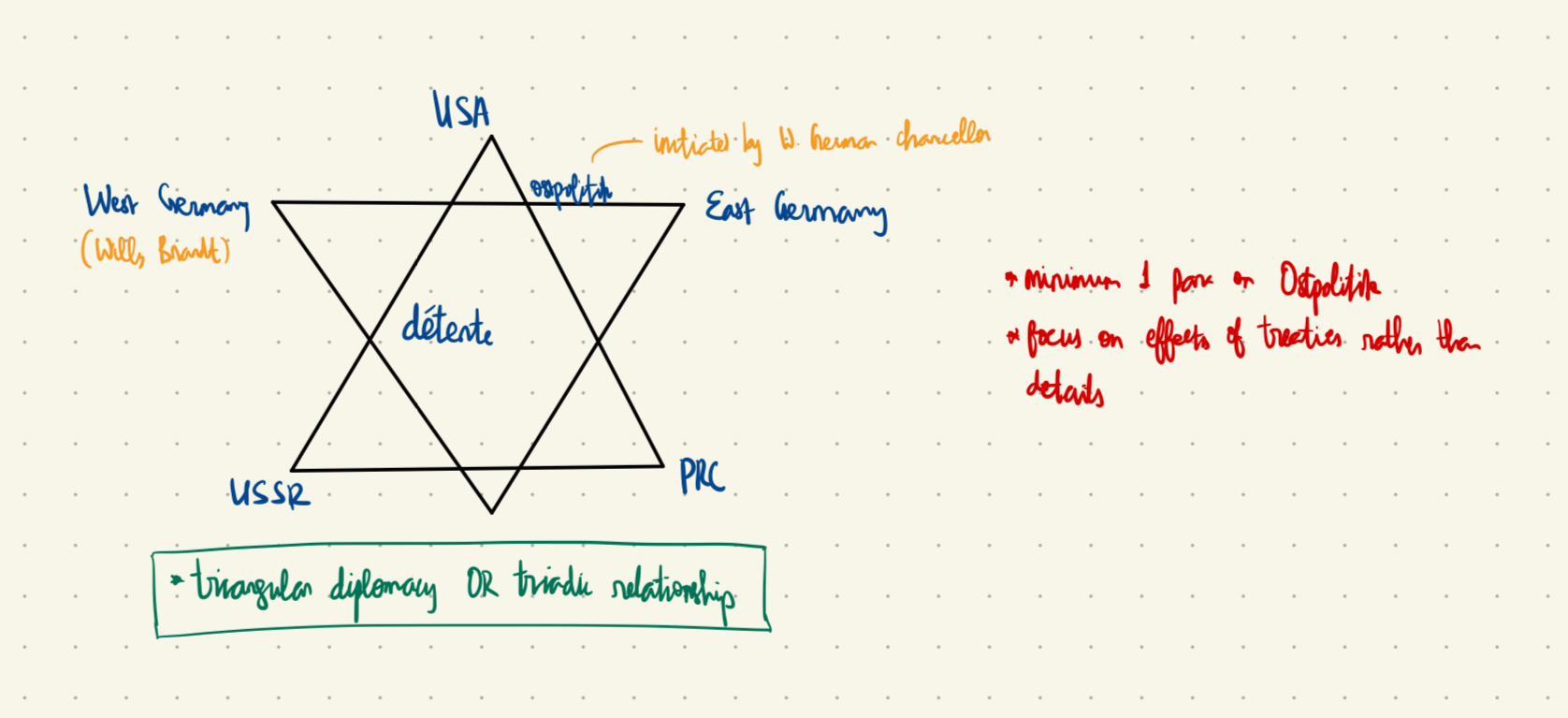
- perception of grave threat from the Soviet Union → Mao lifted conceptual restrictions to improve relations with the U.S.
- 1972 Februrary: Nixon’s high-profile summits with Chinese leaders
- replicated Kissinger’s earlier visits to Beijing in 1971 July and October
- at the core was common concerns over the Soviet threat
- Mao did not follow détente exactly with the U.S., still seeking the "liberation" of all oppressed nations and peoples
- 1976: brief power struggle following Mao’s death; Hua Guofeng rises over Mao’s choice of Hua Guofeng
- Deng opened China to international capitalistic rapid economic development and ended China's support for revolutionary states
- under Deng, foreign policy was more balanced
- 1982: China calls its foreign policy “independent” at the 12th National Congress of the CCP
Conclusion
- foreign policies shifted based on what they prioritized/needed at the time → not rooted purely in ideology, and still somewhat pragmatic
- China was not involved in the Cold War or in vital territories for spheres of influence; its influence stemmed from its huge population and territory
- Sino-American rapprochement helped create conditions leading to 1969-1979 Détente in the Cold War
- ironically, Sino-Soviet rivalry led to collapse of the Communist bloc + end of the Cold War
Historiography
“During the Cold War, China was the only major country that stood at the intersection of two superpower camps, a target of influence and enmity for both.”
–Andrew J. Nathan, Robert S. Ross
Past-Year Questions
- Discuss the reasons for, and the results of, the breakdown of Sino-Soviet relations by 1976. (2017)
- To what extent were China’s relations with other states in the region successful in the second half of the 20th century? (2014)
- Evaluate the foreign policy of China’s government between 1949 and 1976. (2012)